Wednesday, May 21, 2014

Hyderabad Metro Rail – ‘Green Transport’


The world today is at the cusp of major changes and challenges. One such challenge involves the potential effects of pollution and damage to the environment with growing cars and other individual modes of transport that emit pollutants. In the absence of an effective public transportation system in a highly populated country like India, this problem only gets exacerbated.
The solution lies in operating Mass Rapid Transit Systems, which can carry a very high number of commuters across major corridors, thereby reducing pollution on a large scale. The manner in which a company reduces pollution is defined in terms of carbon footprint that represents the total greenhouse gas emissions that an organization, product, or person generates. Greenhouse gases released by vehicles directly affects the environment, resulting in global warming and unprecedented climate change.
Hyderabad Metro Rail is the largest public-private-partnership project undertaken anywhere in the world for a Metro Rail Project. The project has been designed and conceived to reduce environmental pollution. The metro rails are expected to generate around 35 to 40 per cent of its power from the in-built braking system, which again saves the need for extra power, and burning of coal for power generation. Hyderabad is among the fastest growing cities of the world with thousands of cars, buses, and other private transport operators operating each day releasing large proportion of greenhouse gases. Hyderabad Metro Rail is designed in such a way that commuters are encouraged to take up this ‘green’ transport, which can also reduce the commuting time. According to experts say Hyderabad Metro can reduce carbon footprint by more than 3,000 tons per annum, an unprecedented achievement by any yardstick for a modern transport system.
Delhi Metro has already earned global reputation for energy conservation and Hyderabad Metro Rail designed with a capacity for more than 60,000 passengers on a peak hour can contribute in no small measure for a green Hyderabad. This is a testimony to the efforts of L&T Company in creating sustainable and environment-friendly engineering solutions.

Wednesday, May 14, 2014

HMR’s plans for a gender-safe Metro!


The arrival of Hyderabad Metro Rail is viewed with a lot of anticipation from every section of Hyderabad. In an era where ineffective public transport systems have plagued the city’s growth, Metro is nothing less than a boon. One of the main features of Hyderabad Metro is its emphasis on a gender-safe Metro because it recognizes the need where the transport system is not only modern and world-class but also boasts of high safety standards for women, especially taking into account the numerous instances of sexual violence against woman.
In a globalised world, it has become imperative for women to travel at any time in the day to fulfill job and personal responsibilities and they increasingly become a prey to stalkers and other anti-social elements. In this regard, HMR conceptualizes some key features, which is integrated into the safety paradigm of the Metro project.
This includes provisions of closed-circuit cameras, both for visible and invisible surveillance, which can give a sense of assurance as surveillance can deter troublemakers. There will also be separate facilities for frisking and scanning where women not only feel safe, but it can also aid in easily detecting any weapons carried by miscreants into coaches and stations. There is also a provision for separate coaches for women, which is part of measures being planned for making the Hyderabad Metro Rail (HMR) really gender safe. Efforts are on to deploy uniformed personnel and plainclothesmen from the Central Industrial Security Force (CISF), including women officers that would keep a strict watch over metro stations along with private security guards.
The footage from closed-circuit camera will be continuously monitored from the Operation Control Centre (OCC), which is coming up at the Uppal depot where the information is disseminated quickly and security personnel can attend any contingency within seconds. In view of the Delhi gang-rape incident, HMR has embarked on these plans while also inviting suggestions from women across the spectrum to make travel safer. The suggestions were discussed at a Women’s Conclave held in March with participation from businesswomen, NGOs and academicians, woman IAS and IPS officers. The ideas from the conclave were presented to the HMR technical team for implementation during the process of designing coaches and stations. There are even efforts to encourage women entrepreneurs in establishing food courts and shopping centers as part of this project.

Monday, May 5, 2014

Retail spaces at Metro Corridors


The futuristic infrastructure project of Hyderabad, Hyderabad Metro Rail Project is not only expected to revolutionize public transport in the city but the Metro infrastructure is all set to give a fillip to companies and business. The project developers, the government and the common man are absolutely confident of the project’s success and the growing curiosity among the public to quickly use the much sought after transport system is a testimony to this fact. In order to benefit companies in terms of providing spaces for advertising and promotion, Hyderabad Metro is geared fully to create history. The whole corridor spanning 64 stations, depots, terminal stations, transit stations, girders, pillars and the spaces below the viaducts are now open for business at cost-effective prices. All you need to do is choose which space can benefit the most by attracting customers and get more visibility. Brand visibility is the cornerstone for the success of most businesses and when a popular project like Hyderabad Metro Rail Project can provide this, can you ask for more?
Leverage the metro advantage to your advantage. You can get in touch with Metro authorities and see what suits you the best. It is a wise move to know what works best for you and choosing the right place with Metro can add a significant momentum to your business. Apart from outdoor advertising, the 64 metro stations are also open where you can set up your shop!
Each station is expected to have 2000 to 8000 Sq.ft of retail Space. The store sizes vary from 100 to 1000 Sq.ft. The concourse at platform level, entry and exit points are available for you to choose and get set go. Collaborating with metro can be an exciting experience too. Interest parties can set up laundry stores, book shops, kiosks, grocery stores, coffee shop, food courts, gift shops, ATM’s, dispensing units and a lot more. Metro rail is touted to be the most favored transport system in future and is an ideal place to reach customers of all ages and all walks of life. You can customize your outlet as per the area too. For instance, in case you wish to set up a food-catering kiosk, employee hubs like Hi-tech city station can be a smart choice. For apparels, you can choose stations like Koti, Secunderabad etc. You have 64 stations to choose from and make best use of the opportunity to boost the success of companies. Metro is open for corporate and individual business, branded companies and others. A date with Metro for promotion, advertising and retail outlets, promises galore!

Thursday, May 1, 2014

L&T Hyderabad Metro Rail- Reducing Carbon footprint


A carbon footprint is defined as the entire sets of greenhouse gas emissions that an organization, product event, or person generates. Transportation, land clearances, consumption of food, fuels, materials, wood, manufactured goods, roads, and services emit Greenhouse gases which is usually expressed as the amount of carbon dioxide, or as an equivalent of other Greenhouse Gases. Carbon footprint is a measure of carbon use and is an indicator of unsustainable use of energy.
Hyderabad Metro Rail is the largest metro rail project taken up on public-private-partnership mode anywhere in the world. It is also the single largest urban development project taken up by L&T with an investment to the tune of Rs 18,000 crore. There are many features of this project which serves to reduce the carbon foot print and thereby contributing for the overall well being of the environment. The project envisages driverless trains which is operated by communication-based track control system. In an effort to reduce the carbon footprint, it is expected to regenerate around 35 to 40 per cent of its power from the in-built braking system. Hyderabad is a global city today with thousands of buses, cars and other private means of transport plying each day which releases enormous amount of greenhouse gases. It is expected that once the Metro Rail takes off, then people will be more encouraged to take up the alternative means of transport and it will also shorten travel times by around 50-70%. Experts say that this initiative to reduce carbon emissions by Metro can go up to 3,100tonnes a year, which is an achievement of sorts for a modern transport system.
Delhi Metro is a pioneer in this regard wherein the contributions made in reducing greenhouses gases and carbon footprint has helped the corporation earn ‘carbon credits’, a lucrative feature in emerging markets in terms of energy conservation and using the credits gained elsewhere profitably.  The metro project is designed with a capacity of carrying around 40,000 passengers per one hour in a peak direction which is now scaled up further to 60,000. This will also help the environment of Hyderabad reducing air pollution and make great contributions towards a green and clean Hyderabad.

Thursday, April 17, 2014

Hyderabad Metro Rail…..What is in for me?


Metro, this is the buzzword occupying headlines for last few years making the common man of Hyderabad curious as to what is in store for them. L&T Hyderabad Metro Rail is all set to change the way public transport system is defined in India and particularly in Hyderabad where the project is moving ahead at an impressive pace.
Connecting three important corridors of the city, the project heralds many benefits that is expected to unfold in the years to come. While some feel that hassle-free travel through a Mass Rapid Transport system can save time, there are others who express confidence that it also saves a lot of money for commuters. According to some denizens, it saves both time and money. Well here is an interesting contest where you can participate and share your view regarding how you think the Metro project can benefit you.

Does it save time or money or both? Join the exciting contest and win prizes.

Friday, April 11, 2014

Features of the L&T Hyderabad Metro Rail Project

World-class infrastructure for a Global City. This sums up the contribution of L&T Hyderabad Metro Rail Project to the city of Pearls & Nawabs. Considered to be the world's Largest Public-Private Partnership Project (PPP) in the Metro Sector, it is a Mass Rapid Transport System and once completed the project is expected to add a fresh impetus to Hyderabad’s growth story as the preferred city in India.
The project features integrated urban transport planning and incorporates inter modal connectivity accompanied with convenient sky-walks, that ushers a new phase of seamless commuting in India. L & T Hyderabad Metro Rail Network’s first phase covers a total distance of around 72 Km for three corridors namely Miyapur-LB Nagar, JBS- Falaknuma and Nagole -Shilparamam. The project boasts of many features:
·         Links major offices, retail and residential regions of Hyderabad with two tracks ensuring passage of trains in onward and return direction.
·         Passes through major public transport (bus) hubs such as MGBS, Koti, Dilsukhnagar, Miyapur, Charminar and Jubilee Bus Station where
·         Connects Secunderabad, Begumpet and Nampally rail terminals.
·         Connects with MMTS services at Bharatnagar, Begumpet, Khairatabad, Malakpet & Falaknuma
·         Provision for feeder bus stations.
·         World-class elevated stations for every one kilometer.
·         Least carbon foot print and a green mode of transport that reduces pollution
·         Reliable and fully air-conditioned travel in less time.
·         World-class and ultra-modern coaches.
·         Less wait time with high frequency schedules.
·         Separate staircases for elderly & disable
·         User friendly metro stations with modern elevators
·         Parking facility at important hubs/locations.
·         Hassle free entry by means of Automatic fare collection system
·         Reduced wait time at counters through Automatic ticket vending machines
·         Public amenities at stations such as public address and information system, toilets, telephones & ATM’s.

In addition to these features, L & T Hyderabad Metro is all set to implement transit-oriented development model that involves planned development of areas along the metro corridor with pedestrian friendly initiatives, high-density and quality development spanning outwards from a radius of 1-1.5 kilometers from the metro stations.

Friday, April 4, 2014

Transit-Oriented Development ….A Giant leap for Hyderabad

Modern Infrastructure is making new strides and with growing population densities, urban traffic management has become a nightmare.  In a densely populated nation like ours, especially in our cities, demolishing buildings and axing trees to widen arterial roads were conceived to be an ideal solution for accommodating the growing traffic volume, but there is also a growing realization that this is not the right solution because within no time these wide roads get clogged. Hence the need for a smart and futuristic solution in the form of a Metro has been mooted. Also an integrated development plan along the length and breadth of the L& T Metro corridor in Hyderabad is planned for a holistic development of the communities and neighborhoods involving a concept called Transit-Oriented Development (TOD).
This represents a mixed-use of the nearby residential and commercial areas closer to the metro rail route to enable maximize access to public transport but also to encourage transit ridership. A transit-oriented development model features a transit metro station and the nearby bus stop or rail road surrounded by areas of relatively high development spreading outward from the center progressively towards areas of lower-density development. These are usually located within a radius of one-quarter to one-half kilometer from a transit stop, which is also a boon for pedestrians. This trend has gained credence due to growing tariff congestion, a desire to stay in urban areas and experience quality urban lifestyle and creation of smart growth opportunities for individuals and businesses living close to the metro corridor.
The concept entails highest priority to pedestrian walkways, often neglected in our urban planning. Metro station emerging as the prime focus of an area it offers proximity to office, retail and residential spaces followed by quality growth and development within 5-10 minutes of walkable distance from the metro corridor. An integrated transport network with access to other modes of public transport and mini buses results in a win-win situation.
Transit Oriented Development has become a huge success in Delhi where Metro has transformed the manner of living and quality of life in the areas abutting the metro corridor.  It enables better quality of life, better place to live, play and work, reduced traffic congestion, higher and stable property values, more foot traffic and less scope for accidents. This model enhances the overall economic efficiency of a city along the metro corridors and ushers economic competiveness. This model of development witnessed good growth and patronage in big and medium cities of North America and Europe and with L & T Hyderabad Metro picking pace, the time has come for Hyderabad to take a giant leap in terms of infrastructure.

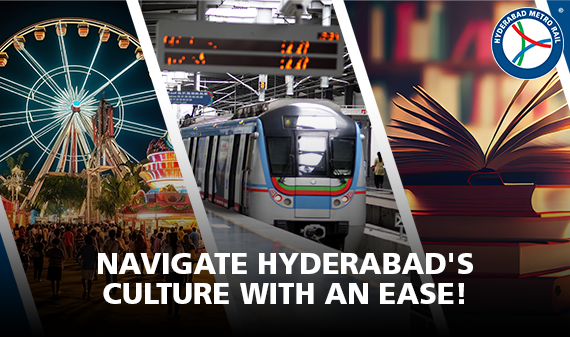
Navigate Hyderabad's Culture with an Ease!

  In the heart of the city of Nizams, where tradition meets modernity in a harmonious dance, a cultural spectacle unfolds. From the regal Nu...